Customer expectations are evolving faster than ever. In the past, providing support through a single channel—usually email or phone—was sufficient. Today, customers want to connect with businesses on multiple platforms, including live chat, social media, WhatsApp, email, and even in-app messaging.
This shift has made omnichannel customer support the future. Businesses that fail to adopt it risk slower response times, frustrated customers, and lost opportunities.
In this blog, we’ll explore the evolution from single-channel to omnichannel support and why this transformation is critical for success.
What is single-channel customer support?
Single-channel support refers to businesses interacting with customers through one primary channel. Common examples include:
- Support via phone only
- Email-only support desks
- Live chat on a website
While simple, single-channel systems often lead to:
- Missed messages when customers try other platforms
- Limited customer visibility for agents
- Repetition and frustration for both customers and agents
The rise of multichannel support
As digital communication channels expanded, businesses moved toward multichannel support. This means offering multiple contact points—phone, email, chat, social media—but each channel often works in isolation.
Challenges of multichannel support include:
- Customer context can be lost when switching channels
- Agents need to check multiple tools for history
- Inconsistent responses across platforms
While better than single-channel, multichannel support still struggles with continuity and efficiency.
What is omnichannel customer support?
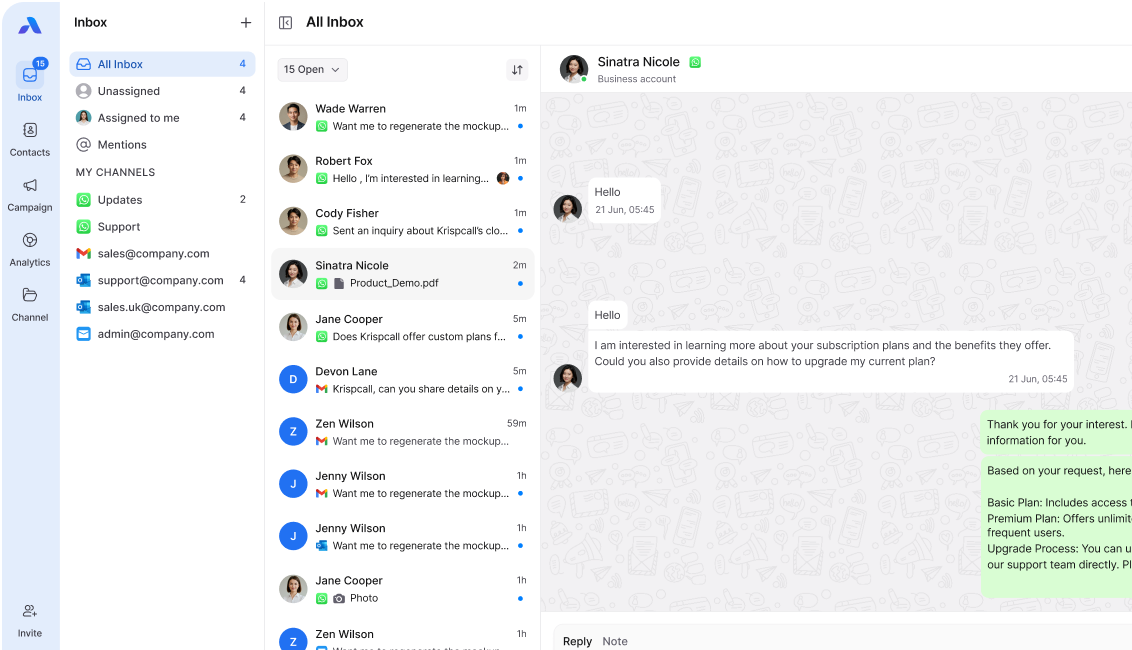
Omnichannel support takes multichannel a step further by integrating all communication channels into a unified system. Customers can start a conversation on WhatsApp, continue on email, and finish via live chat—without repeating themselves.
Key features of omnichannel support include:
- Unified inboxes for all channels
- Contextual conversation history across platforms
- Automated routing and intelligent escalation
- Seamless integration with CRM systems
- Analytics and reporting across channels
Benefits of moving to omnichannel support
- Improved customer experience
Customers enjoy smooth, personalized interactions without repeating themselves. - Faster issue resolution
Agents have full context, reducing response times and increasing first-contact resolution. - Higher agent productivity
Unified workflows prevent wasted time switching between platforms. - Consistent brand experience
Messages are aligned across channels, creating a professional and reliable impression. - Data-driven insights
Omnichannel systems provide metrics that help optimize support strategies and resource allocation.
Best practices for adopting omnichannel support
- Audit your current channels → Identify which channels your customers use most.
- Integrate with CRM and automation tools → Ensure all customer data is accessible in one place.
- Train agents on workflows → Teach teams to handle conversations seamlessly across platforms.
- Use AI and smart routing → Automatically direct queries to the right agent or team.
- Monitor performance and adapt → Track KPIs like response times, resolution rates, and customer satisfaction.
The future is omnichannel
Single-channel support is becoming obsolete, and even traditional multichannel approaches cannot meet modern customer expectations. Businesses that embrace omnichannel customer support will:
- Deliver faster, more personalized service
- Reduce agent workload and burnout
- Gain competitive advantage through superior customer experiences
Final Thoughts
The future of customer support is connected, seamless, and intelligent. Omnichannel support allows businesses to meet customers where they are, maintain context across channels, and provide faster, more satisfying solutions.